Scaling up build-to-rent: research sets out reforms to lift productivity
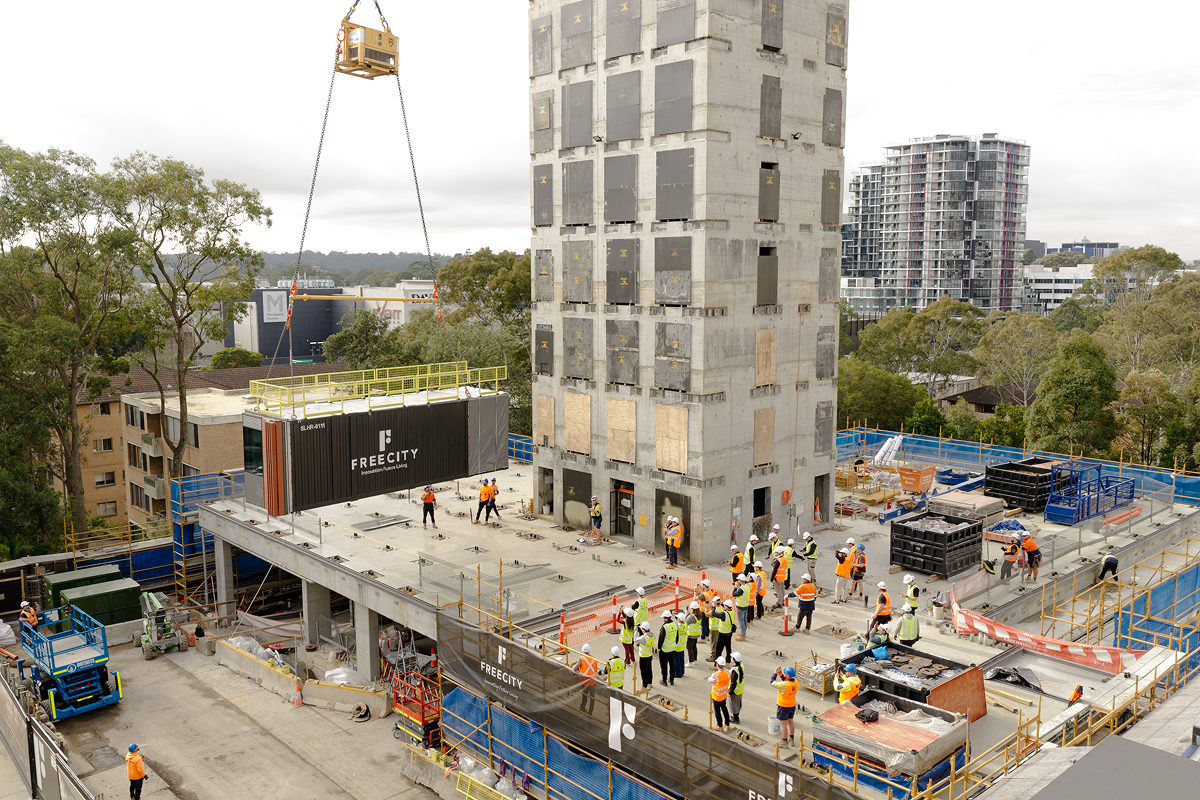
Australia has the tools to deliver more rental housing faster, but outdated tax, finance and planning settings are preventing Build-to-Rent (BTR) and Volumetric Modular Construction (VMC) from reaching their full potential, according to global research by the University of Melbourne released yesterday.
Commissioned by Freecity, the Enabling Volumetric Modular Construction in Australia’s Build-to-Rent Sector – International Policy and Governance Recommendations report compares Australia with the United Kingdom, Canada, Singapore and the United States. It finds that BTR housing and VMC – where apartments are manufactured and fitted out in a factory before being craned into place – have powerful synergies. BTR buildings have hundreds of repeated apartment layouts and a single owner who holds the asset long term. VMC can cut construction timelines by 25 to 50 per cent, delivering significant productivity gains.
However, the VMC-BTR housing delivery model is being held back by systems that have not evolved to match many global exemplar cities. BTR represents just 0.2 per cent of Australia’s residential market value, compared with 5.4 per cent in the UK and 12.0 per cent in the US. The report finds that increasing the BTR market does not come at the expense of home ownership. Instead, it addresses an emerging gap in the housing market, driven by rapid demographic change and sustained growth in demand for rental stock. The UK and the US both have larger BTR sectors than Australia and similar rates of home ownership.
The report examines what has driven BTR growth overseas, the policy settings that have supported it and how modular construction could help Australia accelerate housing delivery.
Freecity Chief Strategy Officer and report co-author, Steven Mann, said: “It’s rare for a country to have the chance to grow a new type of housing. BTR is already one of the largest property investment markets in the world and Australia only started delivering it this decade. We believe modular BTR is well suited to delivering high-quality rental homes in large numbers and if Australia can match the growth rates of the US and the UK, it could be delivering more than 10,000 homes per annum by the next decade.”
The University of Melbourne research comes at a time when BTR new construction starts have stalled. Apartment construction costs have risen by about 80 per cent over the past decade, from $2,500 to $4,500 per square metre. More than 26,500 BTR apartments approved since 2023 have not started construction, 64 per cent of the approved BTR pipeline.
The research report identifies six areas where Australia’s settings work against BTR, modular construction, or both: tax, finance, incentives for modular construction, planning, certification and insurance, and logistics. Addressing GST is one of the six priority actions the report outlines. A developer building apartments to sell passes the GST on to purchasers and the operator of a hotel or serviced apartments can claim back the GST. However, a BTR owner can do neither, since residential rent is input-taxed and carries the full 10 per cent as a cost it never gets back. The research shows that Canada removed GST from new purpose-built rental in 2023 through a 100% rebate and in the UK it has a similar approach and zero rates VAT on the construction of new homes.
The other five priorities are a national certification scheme for modular buildings; a legal definition of BTR in planning rules in states without one; design guidance for modular BTR projects; a government incentive program; and a review of how Australian institutional investors, including super funds, can have clearer pathways to invest in the BTR sector.
Lead author Dr Xiao Ma, from the University of Melbourne’s Faculty of Architecture, Building and Planning, said: “Modular construction is well proven overseas. In the countries we studied, BTR and modular construction grew quickly where governments provided pipeline certainty through enabling policies such as tax, government-backed finance, planning recognition or guaranteed demand on public land. Most of the barriers we found in Australia hit at the very start of a development (e,.g, financing, planning, and design), when investors are deciding whether a project is viable.”
Freecity funded the University of Melbourne research as it advances a pipeline of residential projects using VMC. Its 528-room purpose-built student accommodation development at Herring Road, Macquarie Park in Sydney is currently under construction and is set to become Australia’s tallest volumetric modular building. The company is also designing a 60-plus level VMC-BTR tower in Parramatta, expected to be the largest VMC building in the world, and has received approval for two residential VMC-BTR towers at Rouse Hill, with Co-Living that will deliver 548 rental homes.
For more information, please contact:
Tess O’Brien
Associate Director, Property and Place
SKMG
E: [email protected]
M: 0449 094 901
About the research
Enabling Volumetric Modular Construction in Australia’s Build-to-Rent Sector: International Policy and Governance Recommendations was prepared by researchers from the University of Melbourne’s Faculty of Architecture, Building and Planning and Faculty of Engineering and Information Technology, with RMIT University, and co-authored with Freecity. The research was funded by Freecity, with support from Urbis, HTA Design and Master Builders Victoria. The report is available at https://doi.org/10.26188/33245196.
About Freecity
Freecity Group is a privately owned Australian property development and construction group shaping the next generation of urban living. Based in Sydney, Freecity specialises in delivering ambitious mixed-use and residential projects that prioritise community, sustainability and future-ready design.
As a pioneer in steel structure high-rise volumetric modular construction (VMC), Freecity is redefining the way Australian cities grow, enabling faster delivery, greater design precision and improved sustainability outcomes. Supported by an integrated development, construction and modular capability through Space Labs Australia, Freecity manages the full lifecycle of each project.
The business currently holds a development portfolio exceeding seven billion dollars and an apartment pipeline in excess of 6,000 units, spanning major urban renewal precincts in Sydney
Published on 8 October 2026