Freecity Innovation Insights No.12 – Built different: what CEDA and Urbis tell us about scaling Modern Methods of Construction
Building more, and building differently
Last year the Committee for Economic Development of Australia (CEDA) released its’ Progress 2050 Strategy which maps a course to achieve sustainable, long-term prosperity for all Australians. This comprehensive economic strategy identifies several weaknesses that have been building over time and addressing them is now critical — the first being that ‘housing affordability has reached a crisis point.’
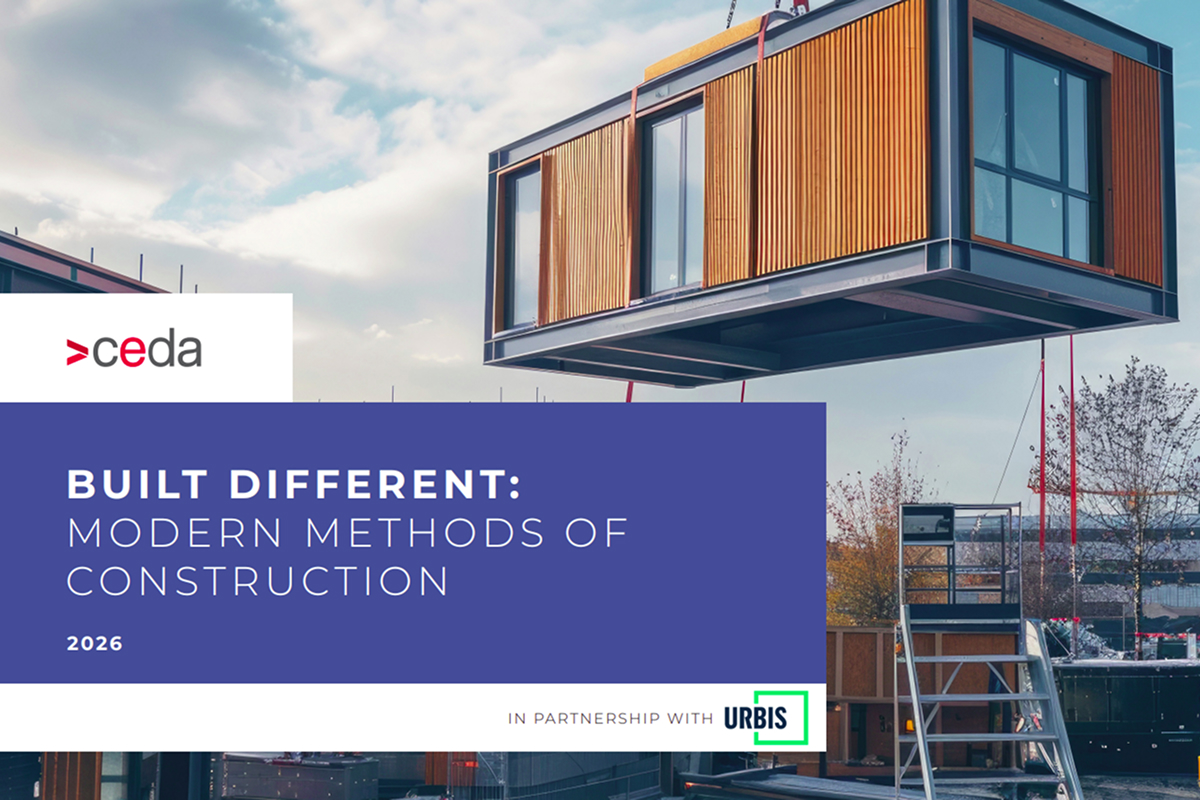
In 2026 CEDA have focused on housing affordability as the key weakness to address, recently releasing its’ second paper “Built Different: Modern Methods of Construction” in partnership with Urbis, urging greater use of Modern Methods of Construction (MMC) amidst the nation’s worsening housing shortage. Freecity was pleased to be invited into a working group to develop this paper.
The paper discusses how Australia’s regulatory frameworks have kept MMC from growing beyond a niche market, with less than 5 per cent of new Australian homes currently built using modular methods. Yet there is potential for so much more, including cutting construction costs by around 20 per cent against business as usual. The MMC paper sets out a vision for what is possible: real-life case studies and encouraging examples from overseas point the way forward. At Freecity, we are studying these international frameworks closely in our research led by University of Melbourne – Enabling Volumetric Modular Construction in Australia’s Build-to-Rent Sector: International Policy and Governance (we will report further on this research later this year), because we believe Australia can draw on those lessons and chart its own route to greater productivity and superior housing solutions.
Lessons learned from abroad
The international experience points to several possible approaches. Some are led locally, project by project; others are driven nationally through government strategy. Canada illustrates the locally-led approach. In Calgary, Attainable Homes Calgary has teamed up with ATCO Structures to progress a pipeline of 1,164 modular homes by 2028. The paper spotlights an 84-unit modular apartment complex built directly across the street from a conventionally built development of similar size. The modular build reached completion well before its conventional counterpart and delivered significant productivity improvements, as shown below.
| Calgary case study metrics | Modular Construction | Traditional Construction |
|---|---|---|
| Units # | 84 | 70 |
| Construction duration | 275 days | 660 days |
| Days to complete a dwelling | 3.27 | 9.43 |
Another approach is policy-led: Singapore and Japan demonstrate the value of embedding modern methods of construction within national development strategies, creating stable demand and sustained institutional support, reinforced by industry–academia cooperation and government-led upskilling. In Japan, around 40 per cent of apartments and 12–16 per cent of new houses is now ‘manufactured’ in timber and precast concrete to exceptionally high standards. In Singapore, factory-built, prefinished modules assembled on site represent 30 per cent of new construction.
State by state approach to MMC: genuine momentum and friction
State-specific conditions explain why Australia lags the international leaders. The core problem is the proliferation of state rules that stop manufacturers operating at scale across boundaries: a module compliant in one jurisdiction can face an entirely different definition, approval pathway and transport regime in the next. CEDA rightly calls to reinvigorate the Seamless National Economy agenda to harmonise them.
New South Wales
NSW is introducing Building Productivity Reforms which aim to fold MMC into the mainstream approval system and accelerate construction. Furthermore, a state taskforce is exploring off-site manufacturing in housing projects. What is missing is structural: no statutory definition, no dedicated state-level planning controls, and inconsistent interpretation council to council.
Victoria
Victoria has committed to building its MMC capacity through a $150 million investment fund for priority industries, and accelerated approvals through the Development Facilitation Program. However, MMC has no statutory definition or specific recognition in the building framework, leaving the regulatory environment ambiguous and open to inconsistent council interpretation.
Queensland
Queensland is using QBuild’s MMC Program to deliver social housing and government-worker accommodation across regional areas, with a pipeline of 600 homes. But the absence of MMC-specific code standards and long transport distances still limit wider take-up.
The pattern is the same across all three States: genuine intent and promising pilots, undermined by the absence of a shared strategy. That is exactly why the federal recommendations matter: they are the mechanism for cutting through state-by-state divergence.
The federal policy recommendations
So what does “Built Different: Modern Methods of Construction” recommend for Australia?
The paper’s headline recommendation is one we strongly support: the Federal Government should set a national target for delivering MMC homes, led by social and affordable housing. That government-backed demand is exactly the certainty manufacturers need to invest at the scale that brings unit costs down.
Alongside the target sits a coherent package of reform. The ‘Modernising the National Construction Code’ review should remove barriers to MMC, and the Australian Building Codes Board should publish nationally consistent MMC definitions ahead of their incorporation into the Code. The report also calls for standardised MMC finance products across the banking sector, and for Transport Ministers, through the National Transport Commission, to harmonise the permit and escort rules for moving larger modules on roads.
These recommendations speak to the obstacles we have met in building our own VMC pipeline across our Living Sector projects. Get the framework right, and the productivity and quality gains MMC has delivered overseas become achievable here.
The bigger picture: housing and CEDA’s Progress 2050 vision
CEDA’s involvement in this type of research is strongly related to its Progress 2050 framework. Progress 2050 rests on two pillars, a strong economy and a strong social compact, and housing speaks to both. CEDA names housing affordability as a weakness at crisis point and a drag on the economy, while weak construction productivity speaks directly to its productivity, investment and innovation focus area. That is what makes MMC such a lever: it is one of the few reforms that pulls on both pillars at once.
Housing sits at the heart of CEDA’s Progress 2050 goals. It is named outright in the goal that all Australians have access to the education, housing and care they need to thrive (Goal 4). It underpins the goal that everyone has the opportunity to live a productive, connected and meaningful life (Goal 5) — a stable, affordable home being among the strongest predictors of opportunity. And it speaks to the goal of fostering competitive, dynamic businesses (Goal 1), since lifting construction, one of the economy’s least productive sectors, is precisely what MMC does.
The real message of “Built Different: Modern Methods of Construction” is that the hard problem is no longer technical: the methods work, the international models are proven, and the States are already moving. What holds Australia back is fragmentation — a gap that, seen through Progress 2050, is costly across housing, opportunity and productivity alike. CEDA identifies that greater use of MMC is a must-have structural change to support long-term goals across the breadth of our economy, and one which is at the core of Freecity’s vision – Innovating Future Living!
Written by Steven Mann
Published: 26 June 2026