Freecity Innovation Insights No.7 – The Inherent Advantages of Volumetric Modular Construction for Living Sector Assets
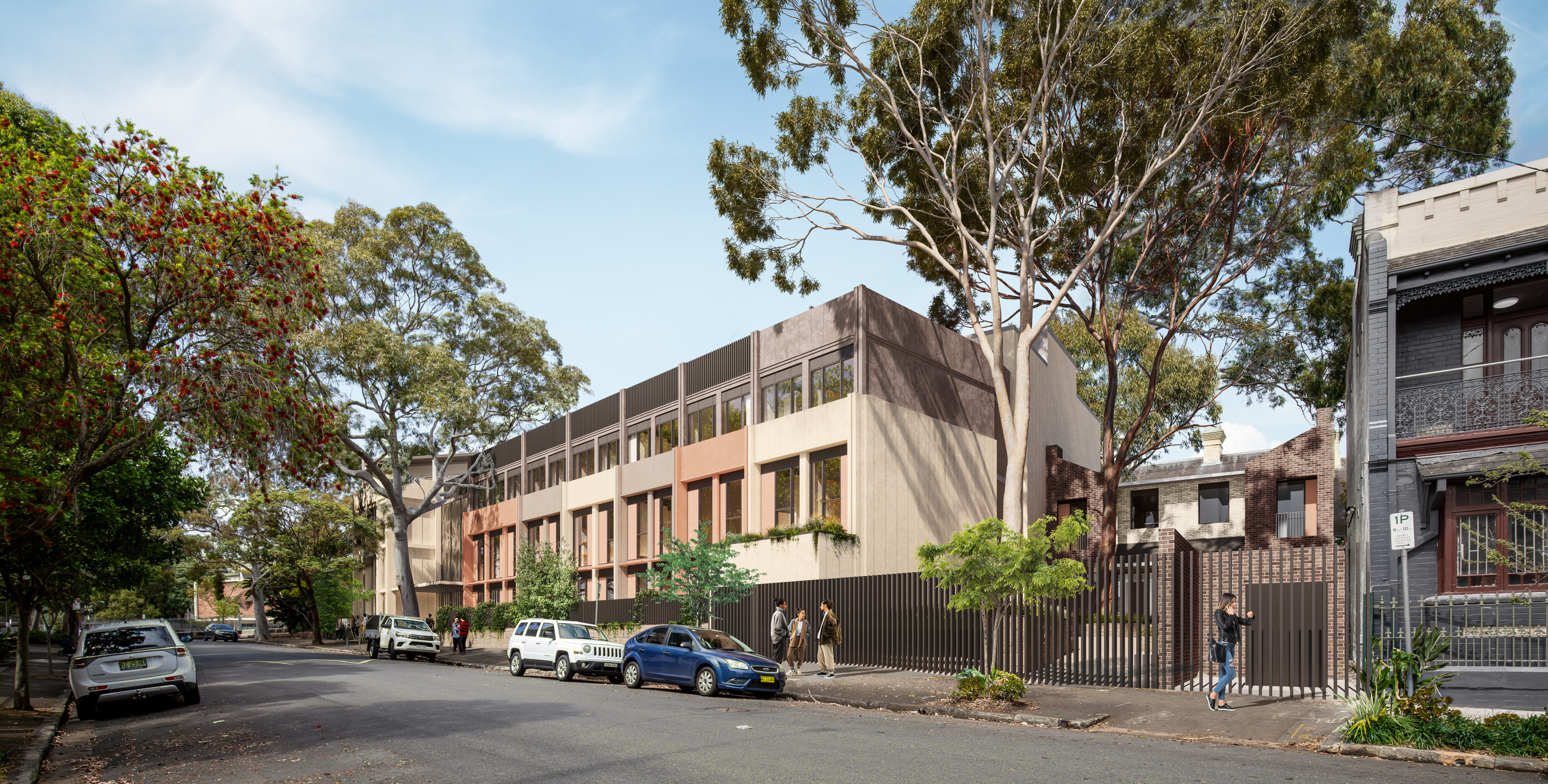
As we enter 2026 with three Purpose-Built Student Accommodation buildings under construction and a growing pipeline of Build-to-Rent and Co-Living projects, we want to share in more detail why Volumetric Modular Construction (VMC) is not simply a construction technique – it is a fundamental rethinking of how high-rise Living Sector assets are designed, built, and operated.
This edition of Innovation Insights opens a new series dedicated to understanding the inherent advantages of VMC for the Living Sector. Over the coming months, we will publish detailed deep-dives into each advantage – unlocking the technical, commercial, and sustainability dimensions that make VMC the right method for our time. Alongside these, we will share real updates from our portfolio as the buildings come to life and the evidence accumulates.
But first: the headline advantages
Why VMC, why now?
Australia’s construction industry needs a productivity revolution.
For decades, productivity in construction has declined relative to almost every other sector of the economy. The causes are well understood – fragmented supply chains, reliance on scarce skilled labour, site-based quality variability, long construction programmes, and a cost structure that makes high-density residential increasingly difficult to stack up financially.
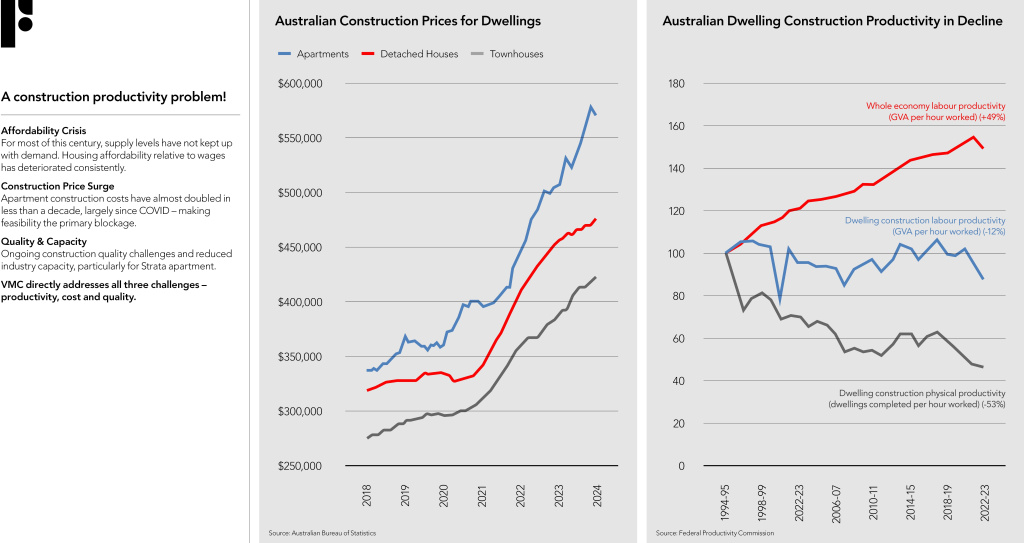
VMC addresses these structural problems directly. By manufacturing entire volumetric modules pre-finished to a high standard in a factory environment, then on-site stacking modules with the building structure in the walls and services connected from the corridor fundamentally changes the time-cost-quality equation. It is not a niche solution, it is growing globally and has the potential to deliver the volume and quality that Australia’s Living Sector urgently needs.
The Headline Advantages
Productivity – Time and Cost Savings
VMC unlocks significant construction programme savings of up to 30–50% compared to traditional build. For large Living Sector buildings, this translates directly into cashflow improvement of 12–18 months – a critical advantage for feasibility in today’s market. Parallel manufacturing of modules while the core and substructure are built on site compresses the programme in ways that sequential, trade-by-trade site work simply cannot.
High Quality and Precision
A factory-controlled environment eliminates many of the variability risks inherent in on-site construction. Temperature, humidity, material handling and trade supervision are all managed within a single facility. The result is a level of fit-out quality – finishes, tolerances and services integration, that is both higher and more consistent than traditional delivery.
Half the Weight of Traditional Construction
VMC modules, using steel-framed construction, are approximately half the weight of equivalent concrete construction. This has significant structural and cost implications – reducing foundation loads and enabling taller buildings on constrained sites.
Repeatability Across Projects
Unlike traditional construction – which largely starts from scratch with each project – VMC builds design and manufacturing intelligence that compounds over time. Each project generation incorporates the lessons of the last. Design details, compliance solutions, supplier relationships, factory processes and logistics knowledge are all retained and refined. This is why Freecity’s approach is intentionally portfolio-based: the benefits of repeatability multiply with scale, and our growing pipeline is structured to capture exactly that.
Low Impact Sites
With modules manufactured off-site and arriving pre-finished, on-site construction is dramatically reduced. Fewer trades, less material storage, reduced vehicle movements, and lower noise and dust impact on surrounding communities. For urban infill sites – exactly the sites Freecity focuses on – this is a significant operational and community relations benefit. The reduction in vehicle movements alone can exceed 85% compared to traditional builds.
Sustainability
VMC offers meaningful sustainability advantages across the building lifecycle. Studies of completed modular projects internationally have demonstrated significantly lower on-site waste generation compared to traditional construction. We expect to see these benefits reflected in our own projects, and we will be measuring and reporting on waste outcomes as our buildings are delivered. Steel-framed construction is inherently carbon-intensive, but Green steel procurement has delivered 30% reduction in embodied steel compared to regular steel, a step in progressively reducing our embodied carbon footprint. Because modules can ultimately be disassembled and repurposed, VMC does align naturally with circular economy principles – and that end-of-life flexibility is a genuine long-term advantage.
Technology-rich Solutions
VMC is inherently compatible with the most advanced construction and building technologies. Digital twin frameworks, BIM integration, structural health monitoring, factory automation and full traceability for the fabrication of each module on a daily basis, and AI-driven design optimisation are all far easier to implement in a controlled factory environment.
The team behind Freecity’s VMC Delivery Capability
Central to that capability is Space Labs Australia – our dedicated VMC procurement and integration team. Together, we are not just adopting VMC; we are building the system required to scale it. Space Labs Australia is a team of architects, engineers, façade engineers and logistics professionals with wide-ranging experience in the design, construction and manufacturing industries across Australia and Asia.
The Space Labs leadership team have delivered the first high-rise modular structures in both Perth, Australia and Auckland, New Zealand – and designed the tallest coreless modular building back in 2015. Two of the Directors have been procuring modular VMC units from Chinese manufacturers for over a decade, bringing a depth of factory knowledge, supplier relationships and logistics expertise that is genuinely rare in the Australian market.
Spotlight: Space Labs Leadership
We are pleased to introduce Angus Kell, our General Manager at Space Labs. Angus brings a rare combination of architectural expertise, executive leadership and deep construction industry experience, including for modular and façade fabrication to the Space Labs and Freecity story.
Angus is a registered architect with over 30 years of experience working across private, corporate, and not-for-profit sectors in the fields of consultancy, construction and manufacturing throughout Australia and Southeast Asia.

Angus Kell
General Manager, Space Labs Australia
Published: 16 March 2026