Freecity Innovation Insights No.8 – Solving for Productivity & Sustainability Must Go Hand-in-Hand
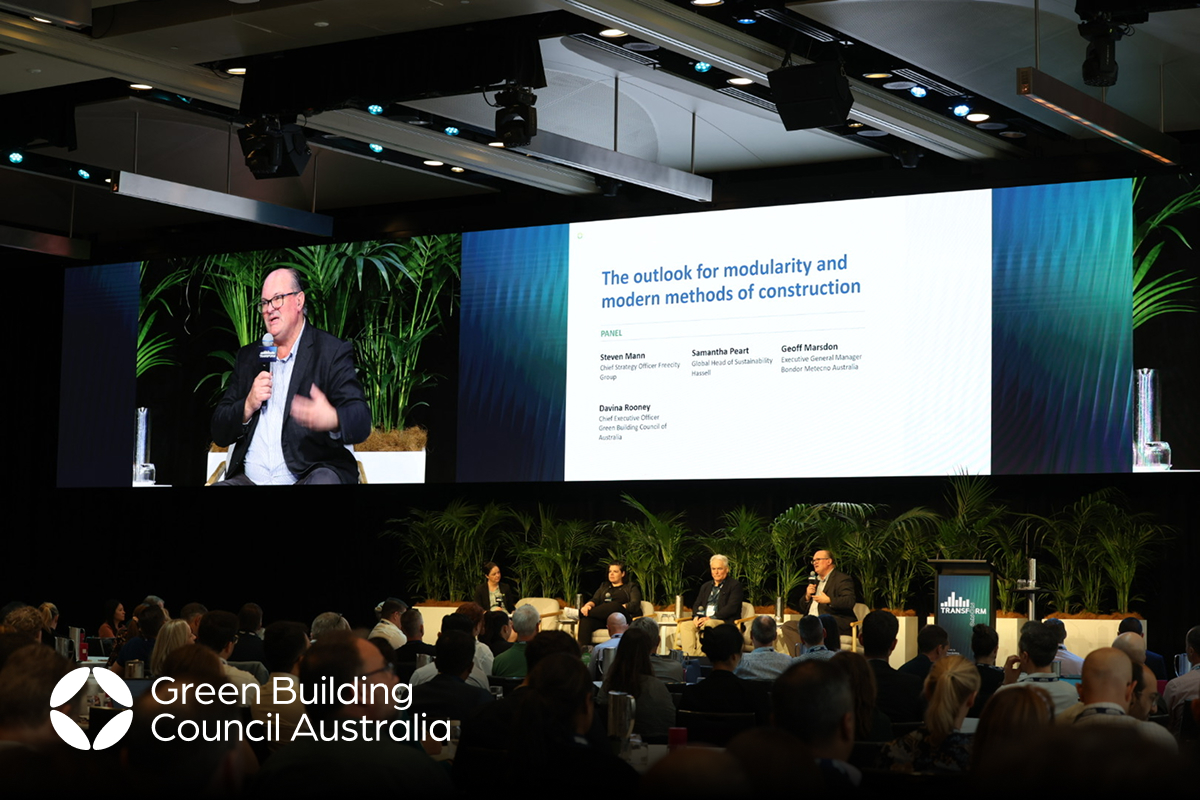
Reflections from the Green Building Council of Australia TRANSFORM Conference
Last week I joined a panel discussion at the Green Building Council of Australia’s TRANSFORM Conference in Sydney, alongside some of the country’s leading voices in sustainable design, innovative manufacturing and construction. The session explored how Modern Methods of Construction (MMC) is positioned to address one of our industry’s most pressing challenges: the imperative to decarbonise the built environment.
The discussion reinforced something we at Freecity have long believed: productivity and ESG are not competing priorities. They are, at their best, natural allies.
The built environment’s dual mandate
The panel opened with a clear framing: the built environment is under enormous pressure to decarbonise faster, use fewer resources, and deliver housing at a scale that our cities have not seen in decades. MMC is increasingly positioned as part of the solution to both sides of that equation, and the TRANSFORM Conference brought together the local players who are doing the hard work of making it real.
It is worth pausing on something that often gets lost in the MMC conversation: apartment living is itself one of the most powerful sustainability levers we have as a society. Compared to detached housing, a well-designed apartment requires significantly less embodied carbon to build, lower impact on the natural environment and far fewer operational resources to run on a per-person basis. Before we even get to how we build, the decision to build density is already doing important environmental work. MMC only makes that choice more viable, more affordable, and faster to deliver at scale.
For Freecity as a long-term owner and operator for our Living Sector assets, the incentive to get apartment-living right is even stronger. Freecity is delivering two thirds of our $6 billion Transit-Oriented Development pipeline as steel structure high-rise Volumetric Modular Construction (VMC) assets: that we are backing with capital, capability, and a fully integrated developer-builder model.
VMC: Productivity and sustainability as one for the Living Sector
One of the most important points I wanted to make at the conference is that VMC’s productivity case and its sustainability case are inseparable. When you think carefully about what modular construction can achieve — factory-controlled production, reduced site waste, less trucks, design repeatability — you realise that the same attributes that drive productivity can also drive better environmental outcomes. Factory production allows teams to optimise from one module to the next, building institutional knowledge that compounds over time.
Based on international examples, VMC generates approximately 75% fewer truck movements compared to traditional construction, with major benefits for noise, waste, and community disruption. Better sealed envelopes and high-quality facades can directly reduce operational carbon over the life of the building.
This last point is underappreciated. VMC carries approximately 65% to 75% offshore procurement compared to around 40% in a conventional apartment build, but the governance model is not weaker, it is stronger. Because fabrication happens in a controlled factory environment, progress tracking and oversight is daily and module by module, creating a fundamentally stronger platform for materials quality control than a traditional construction site can offer.
Living Sector assets create the alignment for this business case to work, where a developer is serious about proving sustainability credentials and delivering quality with greater productivity that can be traced back to every decision made in the factory, this becomes a competitive advantage with customers.
The steel story: embodied carbon and the path to zero
Embodied carbon is the challenge we cannot shy away from. VMC uses a significantly greater amount of structural steel compared to conventional construction, and that carries a carbon cost that must be taken seriously. Materials selection becomes the critical leverage point. Because modular construction is inherently repetitive, whatever material choices are made get multiplied across every module and potentially across multiple projects.
The good news is that steel’s carbon story is rapidly improving for our module fabrication in China. Our first project has procured recycled steel with approximately -30% lower embodied carbon than standard production steel. Steel processed via Hydrogen Shaft Furnace is the next step that can achieve approximately -60% lower embodied carbon, and net zero carbon steel is on the medium-term horizon.
A well-designed modular building is also a circular, reusable, adaptable asset: modules can be disassembled, relocated or repurposed rather than demolished, fundamentally changing the long-term carbon and value equation. Design for disassembly is not an add on, it is baked into the logic of how a modular building is conceived.
Ten Tipping Points from TRANSFORM 2026

Steven Mann
Chief Strategy Officer, Freecity
Published: 27 March 2026